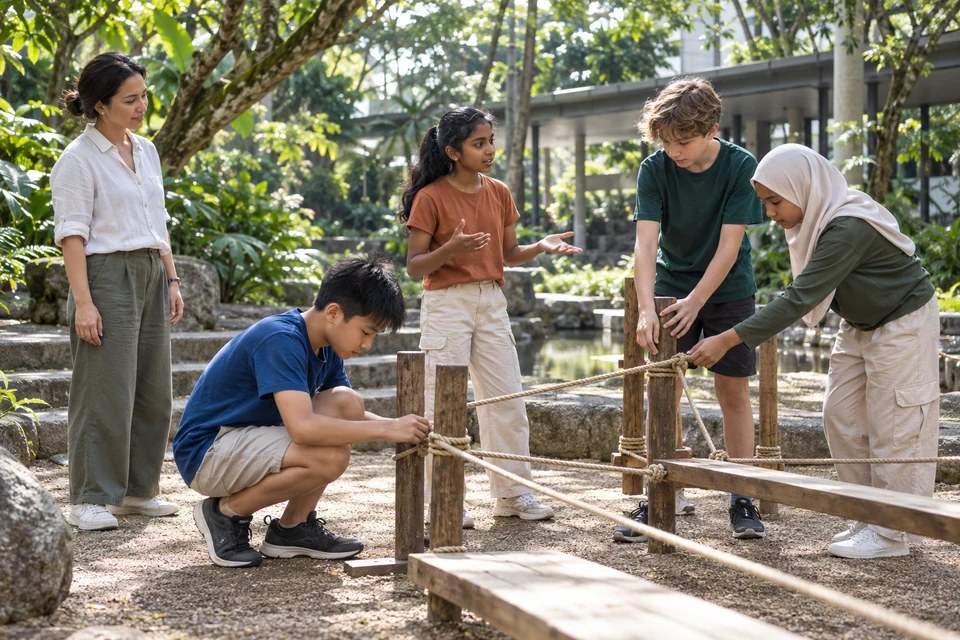
Plan the next setting as deliberately as the lesson. Give learners a recognisable cue, a chance to rehearse, specific feedback and a realistic opportunity to use the skill again.
The right answer can be the easy part
“Listen to the other person.” “Stay calm.” “Ask for help.” These are sensible answers to classroom questions. They are harder instructions to follow when a group is rushing, a friend sounds annoyed or asking for help feels embarrassing.
The classroom answer tells us that a learner can describe a strategy under those conditions. Using it elsewhere may require noticing the right moment, recalling the strategy, adapting the wording and tolerating another person’s response. Each adds a demand.
This is why an engaging workshop and a useful everyday capability are related ambitions, rather than interchangeable achievements. When we plan education beyond academics, we need to ask what connects them.
Otherwise, a programme can teach an attractive vocabulary while leaving the learner to work out when and how to use it. Adults may then mistake the gap for a lack of effort.
Learning depends on context
The National Academies’ synthesis How People Learn II places learning within the interaction of prior knowledge, motivation, culture and environment. Its summary also stresses feedback, suitable challenge and the conditions in which learning is used. It supports attention to context; it does not offer a universal formula for transferring a social skill.1
The Education Endowment Foundation’s metacognition guidance describes teaching learners to plan, monitor and evaluate their learning, and notes that strategies appear more effective when embedded in curriculum and subject lessons. Extending that reasoning to life-skills learning is a design judgement we should test, not an outcome we can assume.2
For a parent or teacher, the useful question is therefore concrete: what will remain familiar when the setting changes, and what will become harder?
Make the moment recognisable
Consider an imagined lesson on constructive disagreement. The learner can use a sentence such as “I see it differently because…” in a role-play. During a group task, however, the disagreement may begin as overlapping voices or someone silently withdrawing.
Before practising the sentence again, help the group identify the cue. What might tell them that they need to pause and hear another view? It could be two incompatible plans, a person repeating themselves or a decision being made before everyone has understood it.
A cue should be observable and usable, not a demand to read someone else’s mind. “When two people propose different ways to begin” is easier to act on than “When the atmosphere becomes negative.”
The learner can then connect the cue with a choice: ask a clarifying question, explain a reason or suggest a small test. Naming the situation gives a strategy somewhere to belong.
Change one demand at a time
Repetition need not mean repeating an identical script until it sounds polished. A second attempt can keep the capability stable while changing one feature of the task.
A learner might first explain a plan to a familiar partner, then to someone who has not seen the materials. The new listener asks a question. Next time, the learner has to explain without pointing at the object. Each version reveals a different part of making meaning clear.
Changing everything at once makes the feedback harder to interpret. If the audience, time limit, language and task all change, we may not know which demand caused the difficulty. A manageable variation helps the learner notice what to keep and what to adapt.
Different learners may need different versions. For a child working in an additional language, vocabulary preparation may be part of the task design. For another, a written planning space may make participation more accessible.
Design the bridge into everyday life
Before the lesson ends, identify an ordinary opportunity to use the skill. A generic instruction to “practise at home” asks families to invent both the setting and the activity. A more useful invitation names a moment: choose one weekend plan together and practise summarising another person’s preference before adding your own.
Keep this small. A transfer task should fit the learner’s actual life and the adults’ capacity to support it. It should not depend on a perfect family discussion, a special purchase or access to a particular club.
In school, the bridge might be a shared phrase that a classroom teacher can use during existing group work. Agree the cue in advance. A partner who knows nothing about the lesson cannot reasonably be expected to reinforce it.
Then bring the experience back. What happened? Was there a real opportunity? What support was used? A report of “I did not try it” may reveal an unrealistic task rather than failed learning.
Feedback needs somewhere to go
“Good teamwork” closes a conversation. “You asked for everyone’s first idea before choosing; next time, check that the quieter person has understood the plan” opens a next attempt.
Offer feedback about an action the learner can recognise. Give them a chance to use it soon enough for the connection to matter. A detailed report delivered after the programme has ended may be informative to adults but arrive too late to improve the practice it describes.
When reviewing progress, distinguish a rehearsed response, a supported use in a new task and a reported use outside the programme. Each tells us something different. None, on its own, establishes that a capability will appear in every setting.
The ambition is not to remove the classroom from learning. It is to make the classroom a deliberate part of a wider route: understand, attempt, adjust and find a useful place to try again.
Sources & further reading
- Research synthesisHow People Learn II: Learners, Contexts, and Cultures — Summary
National Academies of Sciences, Engineering, and Medicine · 2018
Summary chapter; learning across settings and the lifespan.
- Evidence-informed guidanceMetacognition and Self-Regulated Learning, second edition
Education Endowment Foundation · 2025
Public guidance overview and practitioner-resource descriptions; primarily classroom learning.
About this piece
A Figured perspective informed by the sources listed above. The practical examples and planning tools are editorial proposals; they are not reports of programme outcomes. Read how we publish or send a question or correction.