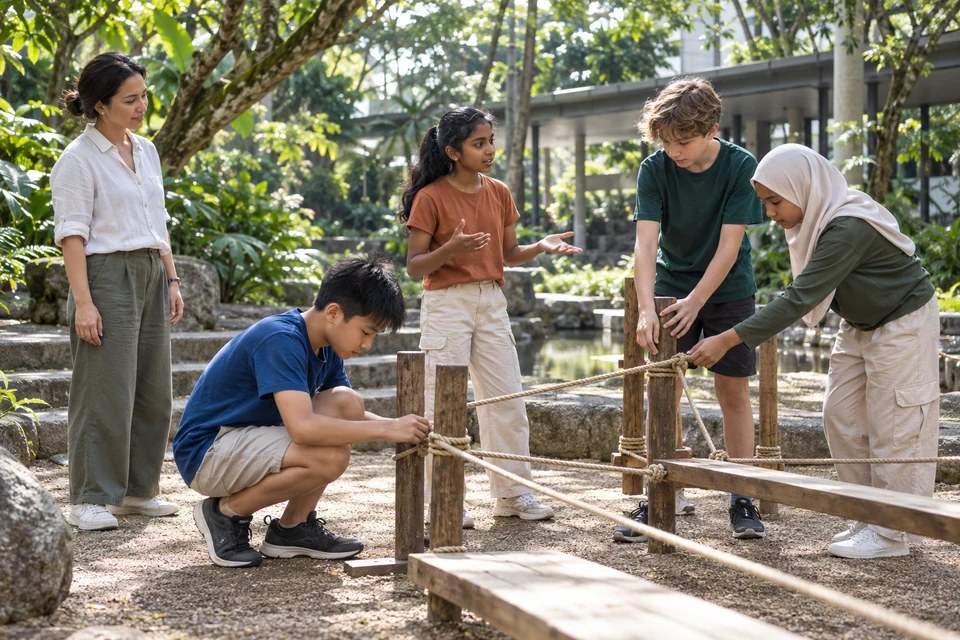
Separate the quality of a tool-assisted output from the learning it demonstrates. Ask learners to explain choices, verify important claims and show what they can do when the tool is absent.
The polished answer is only one kind of success
A young person brings a clear plan for a project. The structure is sensible, the wording is confident and the alternatives look well considered. An AI tool helped create it. Has the learner understood the problem more deeply, or mainly acquired a better-looking document?
The answer depends on what happened during the work. Did they define the goal, examine the suggestions, check the assumptions and make a choice? Can they explain why one option fits the situation? What happens when someone asks a question the draft did not anticipate?
These questions do not require adults to reject the tool. They require us to keep the purpose of the activity visible. Producing a useful result and developing a capability can support one another, but one does not prove the other.
That distinction matters far beyond homework. It applies when a learner uses a tool to prepare a presentation, consider a budget, draft a message or organise a group decision.
A study worth reading carefully
Bastani and colleagues’ 2025 field experiment compared two GPT-4 tutor designs in high-school mathematics. Access improved performance during supported work, but students using the less constrained version performed worse after access was removed; safeguards in the tutor design largely mitigated that effect. These findings concern a particular subject, age group and tool configuration. They should not be treated as a verdict on every use of AI.1
The study makes a distinction worth carrying into educational design: performance while receiving assistance and learning that remains available afterward are separate outcomes.
A family or school can apply that distinction without recreating an experiment. State what the learner is meant to develop, decide which parts assistance may support and include a way to see the learner’s own understanding.
Four capabilities to keep in the learning
Framing a worthwhile question. Before asking a tool for ideas, a learner can describe the situation, the people affected and the constraints. The quality of the problem definition remains part of the work.
Checking a claim. A fluent answer may contain an unsupported detail. For an important factual claim, ask what source would be appropriate and whether the source actually supports it. A generated citation is a starting point to verify, rather than evidence in itself.
Explaining a judgement. Choosing an option calls for reasons. A learner should be able to say what they accepted, what they changed and what trade-off remains. The explanation need not use sophisticated vocabulary to show thoughtful work.
Taking responsibility with others. A message drafted by a tool still enters a relationship. A group plan still assigns work to real people. Discuss who needs to understand or agree, and who is responsible if the suggestion is wrong.
These are proposed learning priorities, not a prediction that particular abilities will be immune to technological change.
Design the task around the learning
Consider an imagined activity in which a group plans a small school event. An educator could provide two fictional plans, one of which contains a hidden scheduling conflict. The learners identify the affected people, compare the assumptions and explain a revision.
The learning does not require a child to create an AI account or enter personal information. An adult can prepare suitable materials. If a school chooses to use a live service, its age requirements, permissions and data arrangements need to fit the learners and the setting.
A second version of the task can remove the prepared suggestions. Can the group still identify the constraints and propose a workable sequence? This gives the educator a different view of understanding from the first polished output.
Keep the purpose explicit. If the task is about using a tool efficiently, assistance may be central. If it is about planning independently, the observation needs to include work that the learner does themselves.
Keep agency within the design
UNESCO’s guidance calls for an approach to generative AI that attends to human agency, age appropriateness and educational purpose. It is policy guidance rather than an evaluation of a specific classroom routine.2
In Singapore, MOE’s 2026 announcements include strengthening AI literacy and attention to validating AI-generated information. The announced changes include future measures; a policy announcement should not be read as evidence that every classroom already uses them.3
For international and local school communities alike, the practical challenge is to turn a broad ambition into shared expectations. What can learners use? What must they disclose? What do they need to verify, and which parts of the task demonstrate their own thinking?
Questions that remain useful as tools change
Parents do not need to master every product before asking a useful question. “How did you decide that was a good suggestion?” invites a different conversation from “Did AI do this?”
Teachers can ask learners to annotate a decision, compare an output with a trustworthy source or explain the next step without the draft in front of them. These activities should fit the learning goal rather than become a ritual of suspicion.
Young people also need room to say “I do not know whether this is right.” Checking a claim and seeking help are signs of responsible use, not failures to appear technologically fluent.
The tools will change. A learner’s ability to understand a situation, explain a choice and accept responsibility for an action remains a worthwhile educational purpose in the meantime.
Sources & further reading
- Field experimentGenerative AI without guardrails can harm learning: Evidence from high school mathematics
Hamsa Bastani and colleagues · 2025
Published abstract and article record. High-school mathematics and two specific GPT-4 tutor designs.
- Policy guidanceGuidance for generative AI in education and research
UNESCO · 2023
Public guidance overview on human agency, age appropriateness and educational design.
- Policy announcementCommittee of Supply 2026: Adapting Together for an AI-Transformed Future
Ministry of Education, Singapore · 2026
Published plans for strengthening AI literacy; announced future measures are not treated as already delivered.
About this piece
A Figured perspective informed by the sources listed above. The practical examples and planning tools are editorial proposals; they are not reports of programme outcomes. Read how we publish or send a question or correction.